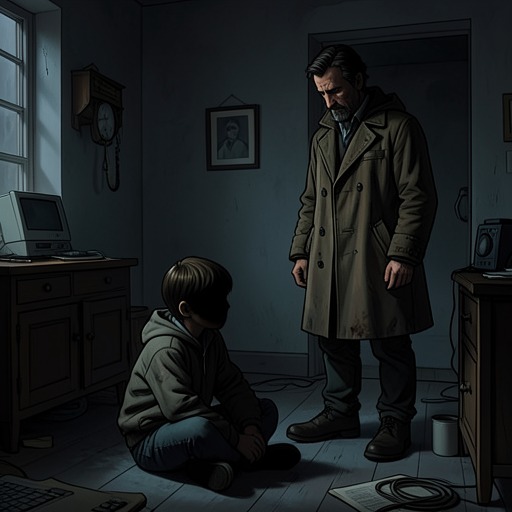
Bill’s overcoat
Small Things Like TheseBill’s overcoat is an ordinary garment that acquires moral force through Bill Furlong’s attempts to protect Sarah Redmond. In two encounters at the convent, he uses it to cover her and help her leave; the second time, she accepts it and leans on him. The coat’s changing place between them gives material form to a relationship built through practical care, while Furlong’s own exposure to the cold registers what that care costs him.
First Use: Protection and Fear
When Furlong discovers Sarah in the coal shed, she is so weak that she is barely able to stand. His first response is to take off his coat and try to put it around her. Rather than immediately welcoming the gesture, she cowers. The coat can offer warmth and cover, but it cannot make the shed or the circumstances that brought her there safe; to Sarah, even help from outside the institution is initially difficult to trust. Furlong explains that he has come with the coal and urges her to come out, then tactlessly shines his torch across the floor. His well-intentioned protection is therefore mixed with an awkward failure to shield her from further exposure.
Once he gets her out, Furlong helps her as far as the lorry. Sarah does not seem to want him close, but she leans against the warmth of the bonnet and looks down at the town lights and the River Barrow. Furlong pulls the coat a little farther around her, and this time she seems not to mind. The small adjustment does not resolve her fear or restore her strength; it establishes a limited, immediate shelter in which she can stand and take in the world outside the coal shed. When she says she is out now, the coat accompanies that first recognition of escape without pretending that escape has yet been secured.
A Need the Garment Cannot Answer
At the convent’s front step, the coat is part of Furlong’s physical assistance, but Sarah’s urgent concern is her baby. She asks him to ask about the child, explaining that her fourteen-week-old son has been taken from her and that she does not know where he is. She hopes she might be allowed to feed him again if he is there. The coat can cover Sarah, but it cannot reunite mother and child or tell her where the baby is. That distinction makes its care concrete rather than magical: Furlong can respond to the person beside him, even while the larger power over her life remains beyond the garment’s reach.
The encounter also sharpens the conflict between his practical response and the household’s resistance to involvement. After witnessing what has happened at the convent, Furlong tells Eileen Furlong; she argues that the matter has nothing to do with them and points to the convent’s need for firewood and its reliable payment. Against this reasoning, the coat represents a direct, bodily act: Furlong has taken off something of his own and placed it around someone who needs help. Later, when he is expected to move on, he pauses beside the girl at the kitchen table and asks if there is anything he can do. She looks toward the window, breathes, and begins to cry. The text does not say that he gives her the coat there, but the earlier gesture belongs to the same developing pattern of attention to her immediate needs.
The Return and a Changed Response
Furlong later returns to the convent at night and makes his way around its high walls, whose broken glass remains visible beneath the snow. At the coal-house door he hesitates, imagining that it may be locked, that Sarah may no longer be inside, or that he may have to carry her. When he calls her name and gives his own, she takes his coat and seems glad to lean on him as he leads her out. The change is precise: during their first encounter she cowered and resisted his closeness; now she accepts both the garment and his physical support. The coat becomes a point of contact in a trust that has not been assumed in advance but is expressed through her action.
He tells her she will come home with him, then helps her down the drive and hill, past the houses and toward the bridge. As they cross the river, Furlong envies the River Barrow’s freedom to follow its course toward the open sea. The air is sharper without his coat. Its absence makes the exchange tangible: Sarah has the garment, while Furlong continues walking beside her in the cold, still weighing his self-preservation against his courage. He considers taking her to the priest’s house but concludes that the priests already know. The coat does not settle these institutional questions; it records the decision he has made in spite of them.
Material Care and Moral Choice
The overcoat links two moments of rescue without making them identical. At first it is offered to a frightened girl who is wary of being approached; later it is accepted by someone willing to lean on Furlong as he leads her away. Its ordinary function as clothing remains important: this is a direct provision of cover, not an abstract declaration of sympathy. Yet the movement of the garment also traces a change in their encounter, from hesitant contact to practical cooperation.
On the walk home, people Furlong knows notice Sarah’s bare, black feet and react in different ways: some keep their distance, some speak awkwardly or politely, and a child calls her dirty. Furlong asks himself whether life has any point without helping one another, and whether a person can go through life without courageously opposing what is wrong while still calling himself a Christian. His coatless walk with Sarah gives those questions a physical setting. He thinks too of Mrs Wilson’s daily kindnesses and of how her help may have kept his mother from ending up in such a place. In that recollection, care appears as a series of small actions whose consequences can extend across a life. The overcoat is one such action: limited in what it can repair, but unmistakable in the choice to use what Furlong has to hand for someone else.